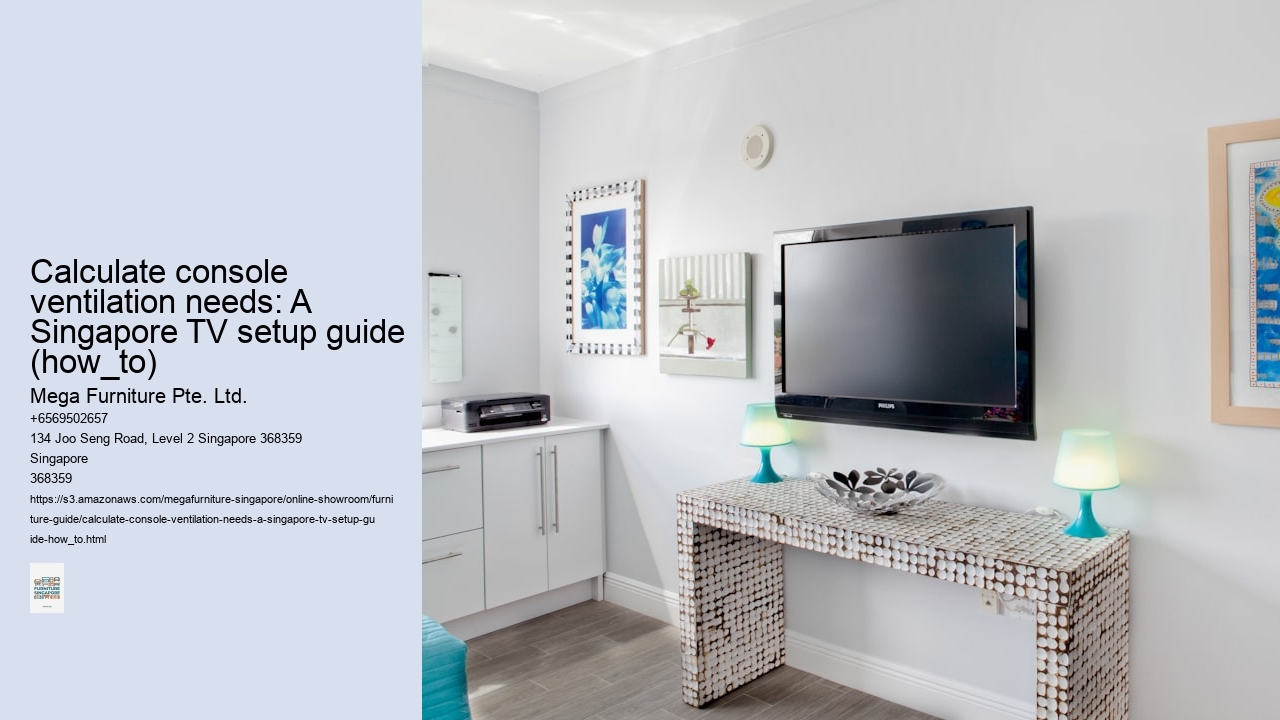
A 75-inch screen in a 4-room BTO living room almost always means a 240-centimetre console below it. That’s a lot of real estate for components to hide, and a lot of enclosed space for heat to build. It’s a silent, slow cooker for your electronics.
Start by adding up the wattage. Check the back of your AV receiver, your PlayStation 5, your media streamer, and any other gear you’ve tucked away. An enclosed PS5 or Xbox Series X under load can pump out far more heat than, say, a slim soundbar or a simple set-top box. That total wattage figure isn't just about electricity bills; it's a direct proxy for the thermal load your console cabinet needs to manage.
In many homes, passive ventilation is enough. The rule of thumb is to ensure the open-back area behind the console is at least 1.5 times the total vent area on your components. For a typical setup, that might mean leaving a 15-centimetre gap between the cabinet back and the wall, or opting for a design with a fully open back panel. If your cabinet is fully enclosed or pushed flush against a feature wall, you’re banking on convection that often isn't there.
When the math doesn’t add up, you’ll need a fan. Active cooling—a couple of quiet USB exhaust fans mounted at the rear—becomes non-negotiable for setups with high-powered receivers and next-gen consoles in a sealed space. It’s a small, inelegant fix, but it’s cheaper than replacing a component that’s fried from its own trapped exhaust. For a curated selection of consoles designed with cable management and airflow in mind, you can browse the options at Megafurniture. The goal is simple: your equipment should last as long as your furniture does.
That dark patch behind your console in a Bedok ground-floor flat isn't just a shadow—it's moisture wicking into laminated particle board, which will swell and distort within a season. This cheap substrate is fine for a dry study cabinet, but it's a poor choice for housing heat-generating electronics near a wall that gets afternoon sun. Solid rubberwood or acacia, while pricier, resist this ambient humidity far better. Treated moisture-resistant MDF is a more budget-conscious compromise that still holds its shape. You'll pay more upfront, but you won't be replacing a buckled console in two years.
Convection is your silent ally. Enclosed consoles trap heat from a PlayStation 5 or AV receiver, creating a miniature oven that stresses both the furniture and the components. Integrating metal mesh panels into the rear or sides transforms a static box into a passively cooled chamber. Warm air naturally rises and escapes through these openings, drawing in cooler room air from below. It's a simple, fanless principle that dramatically extends equipment life in our constant 30-degree climate.
Glass-fronted doors might look sleek in a showroom, but they're a thermal trap for every compartment. Opt for slatted or louvred designs instead, which allow for continuous air movement across your game consoles, routers, and set-top boxes. This is critical for the lower compartments that often house the bulkiest, hottest devices. That steady cross-breeze prevents localised hot spots that can warp shelves and throttle performance. It’s a design choice that prioritises function without completely sacrificing form.
In a compact 4-room BTO living room, off-gassing from adhesives in board materials concentrates quickly. The 'SG Green Label' certification isn't just an eco-badge—it's your guarantee of strict formaldehyde emission limits, which is non-negotiable for family health. Uncertified pressed wood can release these vapours for months, especially when warmed by electronics. Always check for this label; it’s more telling than any salesperson’s assurance about low-VOC finishes. Your media wall shouldn't come with a chemical smell.
A matte laminate might hide fingerprints, but a quality thermofoil or polyester coating is what actually seals the core material from our humid air. Look for rounded, fully sealed edges on doors and panels, as these are the first points where moisture finds a way in. In many homes, the console sits directly under an air-conditioning vent, creating a cycle of condensation and drying that tests any finish. A robust seal here matters more than the specific colour you choose from the TV console range.
The most common ventilation error in a Singapore living room isn't about missing vents—it’s about ignoring the ones you already have. Homeowners will carefully measure for a 180cm console to fit a 65-inch TV, then push the entire unit flush against the feature wall, completely blocking the rear grilles designed to let hot air escape. That trapped heat from your AV receiver and game console just cycles back into the cabinet, a slow-cook scenario that can shorten component lifespans in our year-round humidity.
Open shelving, a favourite for displaying curated objects, often falls victim to a similar airflow crime. Those woven rattan baskets or deep ceramic vases look organised, but placed in front of or directly on shelving bays, they act as baffles that impede the natural convection currents your gear relies on. It’s a subtle mistake; the console isn’t sealed, but the pathway for cool air to enter and warm air to leave is effectively choked.
Then there’s the treatment of concealed storage. The deep drawers and cabinets become a catch-all for winter-weight blankets, spare pillows, and bulky board games. Overstuffing these spaces isn’t just a clutter issue—it creates a layer of insulation around your electronics, preventing heat from dissipating through the cabinet’s own panels. In a 4-room BTO layout where the media console is the room’s central tech hub, that internal heat load builds up fast.
We also tend to overlook smaller heat sources. Placing a Wi-Fi router or a multi-port USB charger inside a cabinet, simply to hide a tangle of cables, adds a constant low-grade heat that the ventilation system now has to manage. Combine that with a console chosen purely for aesthetics—one that’s shorter than the TV’s width—and you create a heat-trapping overhang. The TV’s own exhaust gets deflected down onto the cabinet surface, creating a localised hot spot right where your PlayStation is likely sitting.
The goal isn’t to leave your living room looking like a server room with fans whirring. It’s about mindful placement—pulling the console forward just 10cm, being selective with shelf decor, and treating the cabinet’s interior as a designed environment, not just a black hole for storage. You can browse a range of consoles designed with integrated cable management and strategic venting at Megafurniture’s collection, which helps mitigate some of these issues from the start.
The showroom’s first impression is often a clean, styled vignette—a console arranged with decorative books and a potted plant. The real test starts when you crouch down and look behind it. At Megafurniture’s Tampines or Joo Seng showrooms, you’ll find a mix: some console backs are fully panelled in engineered wood, while others are simply left open, revealing a bare particleboard frame. That solid back panel isn’t just for a finished look; in a 4-room BTO layout where the console sits flush against a wall, it’s critical for directing airflow from rear vents forward, not letting it dissipate uselessly into the cavity. Open every drawer and door. The action should be smooth, with a consistent, quiet resistance—cheap drawer slides feel gritty and often sag over time, creating misalignment. That misalignment matters more than aesthetics; a door that doesn’t sit flush or a drawer with a half-millimetre gap breaks the sealed environment you’re trying to create for components like a PlayStation 5 or AV receiver. It’s a direct leak, letting cool air escape and warm room air seep in. Check for dedicated cable management, usually a series of punch-out holes or a plastic channel running along the back interior. In practice, these channels are often too narrow for a thick UK plug or a multi-socket power strip, forcing you to coil excess wire inside the main compartment. That tangle becomes a heat trap, blocking the very ventilation paths the console was designed with. It’s a common frustration that turns a sleek piece into a cluttered hazard. Finally, experience the unit’s true scale. Showrooms often mock up a living room wall to around 4 metres, the typical width for many HDB layouts. A 240cm console can look proportionate on its own but dominate the space once you mentally add your existing sofa and coffee table. Walk around it, imagine your TV on top, and consider the clearance needed for floor-standing speakers or a robot vacuum. This physical test is something you can’t get from online dimensions alone, and it’s worth the trip to
browse the optionsin person.
A delivery crew hauling a 240cm TV console up a narrow staircase in a 1980s Queenstown block will likely add a surcharge; it’s a standard line item for pre-1990 HDB flats without lift landings on every floor. Confirm this stair-climbing fee upfront—it’s often a flat rate per floor after the fifth storey, and you don’t want that surprise on delivery day. The assembly itself requires a specific local awareness, too. In our humidity, an installer who cranks down too hard on a screw into a particle board panel will strip the thread instantly, leaving a useless, crumbly hole that won’t hold weight; a firm, seated fit is all that’s needed.
This sensitivity to moisture extends to the finished product. When reviewing warranty documents, specifically check two clauses: coverage for shelf sagging under the sustained weight of an AV receiver or gaming console, and for laminate blistering or edge peeling. Many standard warranties cover manufacturing defects but exclude ‘environmental factors’, which is how some retailers classify the effects of Singapore’s 80% average relative humidity. It’s a grey area you’ll want clarified.
A simple, effective habit is to keep a few humidity control packs inside any fully enclosed cabinet section, especially during the relentless rainy season from November to January. That stagnant, damp air inside a sealed unit is what leads to mould on stored items and can weaken board integrity over time. It’s a minor step that preserves the console’s interior.
For a comprehensive look at styles built for our climate, from ventilated media units to solid wood consoles, browse Megafurniture’s collection. Ultimately, a console that survives here isn’t just about looks—it’s about whether the shelving holds up after two years of monsoon cycles and if the warranty acknowledges that reality.
The back of a media console, after a few hours with a PS5 and an AV receiver inside, is often warmer than you’d expect. That’s usually fine. Surface warmth from exhausted air is acceptable; a sharp, pungent plastic smell is not, and likely means a component is overheating or a vent is completely blocked.
How do you manage cat hair intake with all those fans? Use removable magnetic dust filters on the intake vents. They’re a simple retrofit for most units and catch the bulk of fur and dust before it gums up your console’s internals. You’ll need to clean them every fortnight in a pet-owning household, but that’s far easier than dismantling electronics.
Can fan noise be reduced? It can, by prioritising airflow over brute force. Larger, slower 120mm fans move the same volume of air as smaller, high-RPM ones but with significantly less whine. In a 4-room BTO living room, where the TV console sits just metres from the sofa, that difference is the line between immersion and irritation.
For floor-standing units, maintain a minimum clearance of 15cm from the floor. That space stops the console from acting as a vacuum for every dust bunny in the room, and it gives thicker carpet piles in condos room to breathe without choking the intakes. It’s a basic rule that prevents the most common cause of thermal shutdown.
The most common mistake in a Singapore TV console purchase isn't picking a wrong colour — it’s forgetting that a sleek 240cm console often arrives in a 4-room BTO living room that’s only 3.2 metres wide. Measure your wall first, then subtract 60cm total: 30cm spare on each side for speaker placement, because floor-standing towers or bookshelf speakers on stands need breathing room away from cabinet edges. That final width, typically between 180cm and 210cm for many flats, is your actual buying target.
Next, total your equipment wattage. A modest setup with a PlayStation 5, media streamer, and soundbar might draw around 200W; a serious one with an AV receiver, gaming PC, and amplifier can hit 500W or more. Check the console’s spec sheet for adequate CFM for exhaust — if it lists integrated fans, ensure their combined airflow rating matches that heat output. Passive vent slots are fine for lower-power arrays in open-plan condos, but integrated USB-powered fans become essential in enclosed media walls where stagnant air cooks components.
Verify console depth, too. The deepest component is usually an AV receiver, which can be 45cm deep. Add 10cm rear cable clearance for all those HDMI, power, and speaker wire bends — so you’ll need a cabinet interior depth of at least 55cm. Many contemporary floating consoles are only 40cm deep internally; they’ll force you to mount the receiver sideways or leave the back panel open, which ruins the clean look you bought it for.
Finally, decide between passive slots or active fans. Passive vent slots are cheaper and silent, relying on natural convection, which works if your console isn’t packed tight and your living room has decent cross-ventilation from a balcony door. Integrated fans add cost and need a USB port, but they’re the insurance policy for a cabinet stuffed with gear in a humid, air-conditioned room where heat just pools. That decision hinges entirely on your wattage total and your flat’s airflow — a calculation worth doing on paper before you click checkout.
A wall-mounted console in a BTO's 12 sqm bedroom faces a fundamentally different thermal challenge than a floor-standing unit cooling a 30 sqm condo living room. The smaller space concentrates heat, but it's Singapore's ambient 80% humidity that really complicates things-equipment doesn't just generate dry heat, it produces significant latent moisture that the air can't easily absorb. A TV console anchors the wall opposite the sofa in the same way a tall bookshelf anchors a corner — long horizontal piece, mix of open and closed storage, defines the visual weight of one whole side of the room. Megafurniture's TV Console range covers floating wall-mounted designs, low-profile freestanding consoles, and modular feature-wall configurations. Most pieces sit at 40-50cm height, sized for screens up to 75 inches.. You'll need ventilation that actively moves this damp air out, not just a few passive grilles for show. In a compact HDB bedroom, the console is often wedged between a wardrobe and a bed, with airflow restricted to one or two sides. A rear vent here is practically useless if it's pressed against the wall; side vents become critical, and a small internal fan can make a tangible difference in preventing that familiar, musty electronics smell. The goal isn't just cooling, it's dehumidifying the micro-climate inside the cabinet before condensation forms on your PlayStation. Contrast that with a spacious condo living room, where a 240cm media console might sit centrally on a feature wall. The room's larger volume disperses heat better, but the console itself likely houses a more powerful AV receiver, a gaming PC, or a set-top box-all heat sources that run longer during weekend movie marathons. Here, ventilation demands shift from managing cramped stagnation to handling sustained, high-wattage output; deep cabinets with organised cable channels and elevated back panels allow hot air to rise and exit cleanly. Landed property setups introduce another variable: the thermal mass of a tiled or marble floor. A heavy, floor-standing console in a terraced house's entertainment room can benefit from that cool surface, but it also means dust ingress is a real concern-those larger intake vents need fine mesh filters. It's a trade-off between airflow volume and maintenance, a calculation that doesn't even register in a typical BTO. Ultimately, choosing the right console isn't just about aesthetics or length matching your 75-inch TV; it's about matching its ventilation design to your home's specific heat and humidity profile. A well-considered selection from a comprehensive
TV console rangeshould account for whether it's cooling a compact media nest in Tampines or a dedicated home theatre in a Bukit Timah bungalow.
A wall-mounted console in a BTO’s 12 sqm bedroom faces a fundamentally different thermal challenge than a floor-standing unit cooling a 30 sqm condo living room. The smaller space concentrates heat, but it’s Singapore’s ambient 80% humidity that really complicates things—equipment doesn’t just generate dry heat, it produces significant latent moisture that the air can’t easily absorb. You’ll need ventilation that actively moves this damp air out, not just a few passive grilles for show. In a compact HDB bedroom, the console is often wedged between a wardrobe and a bed, with airflow restricted to one or two sides. A rear vent here is practically useless if it’s pressed against the wall; side vents become critical, and a small internal fan can make a tangible difference in preventing that familiar, musty electronics smell. The goal isn’t just cooling, it’s dehumidifying the micro-climate inside the cabinet before condensation forms on your PlayStation. Contrast that with a spacious condo living room, where a 240cm media console might sit centrally on a feature wall. The room’s larger volume disperses heat better, but the console itself likely houses a more powerful AV receiver, a gaming PC, or a set-top box—all heat sources that run longer during weekend movie marathons. Here, ventilation demands shift from managing cramped stagnation to handling sustained, high-wattage output; deep cabinets with organised cable channels and elevated back panels allow hot air to rise and exit cleanly. Landed property setups introduce another variable: the thermal mass of a tiled or marble floor. A heavy, floor-standing console in a terraced house’s entertainment room can benefit from that cool surface, but it also means dust ingress is a real concern—those larger intake vents need fine mesh filters. It’s a trade-off between airflow volume and maintenance, a calculation that doesn’t even register in a typical BTO. Ultimately, choosing the right console isn’t just about aesthetics or length matching your 75-inch TV; it’s about matching its ventilation design to your home’s specific heat and humidity profile. A well-considered selection from a comprehensive
TV console rangeshould account for whether it’s cooling a compact media nest in Tampines or a dedicated home theatre in a Bukit Timah bungalow.